140 Quotes About Robotics and Their Future Impact
Robotics is reshaping everything—from how Americans work to how we explore distant planets. But what does the future of robotics really hold? These 140 powerful quotes from experts, innovators, and visionaries reveal the true impact of robotics on humanity. Whether you’re curious about artificial intelligence, autonomous systems, or human-robot collaboration, these insights will change how you see our technological future.140 Quotes About Robotics and Their Future Impact if you are quotes lover and want to read more quotes than visit Quotes slide.
Quotes About the Future of Robotics
The robotics future is not just coming—it’s already here. Robots are moving beyond factories into our homes, hospitals, and even outer space. Understanding where robotic systems are headed helps us prepare for tomorrow’s world.
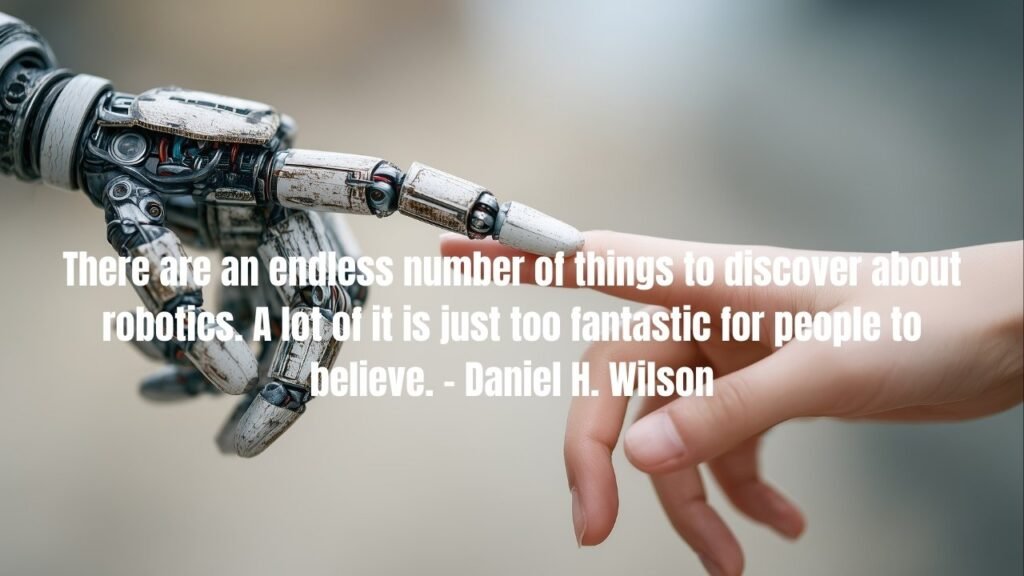
Daniel H. Wilson, a leading voice in robotics research, captures the excitement perfectly. The field of robotics engineering offers endless discoveries that often seem too incredible to believe. Robotic technology continues to surprise even the experts who build it.
The robotics industry exists at a unique intersection. It combines real-world robot technology you can study in universities with the cultural imagination that shapes how people think about intelligent machines. This dual nature makes robotics both practical and inspiring.
Early promises in robotics innovation sometimes outpaced reality. When automation and robotic systems showed preliminary success, expectations soared. But the robotics field has learned from these experiences and now focuses on achievable goals rather than science fiction fantasies.
“There are an endless number of things to discover about robotics. A lot of it is just too fantastic for people to believe. – Daniel H. Wilson”
“Robots are interesting because they exist as a real technology that you can really study – you can get a degree in robotics – and they also have all this pop-culture real estate that they take up in people’s minds. – Daniel H. Wilson”
“Sometimes a technology is so awe-inspiring that the imagination runs away with it – often far, far away from reality. Robots are like that. A lot of big and ultimately unfulfilled promises were made in robotics early on, based on preliminary successes. – Daniel H. Wilson”
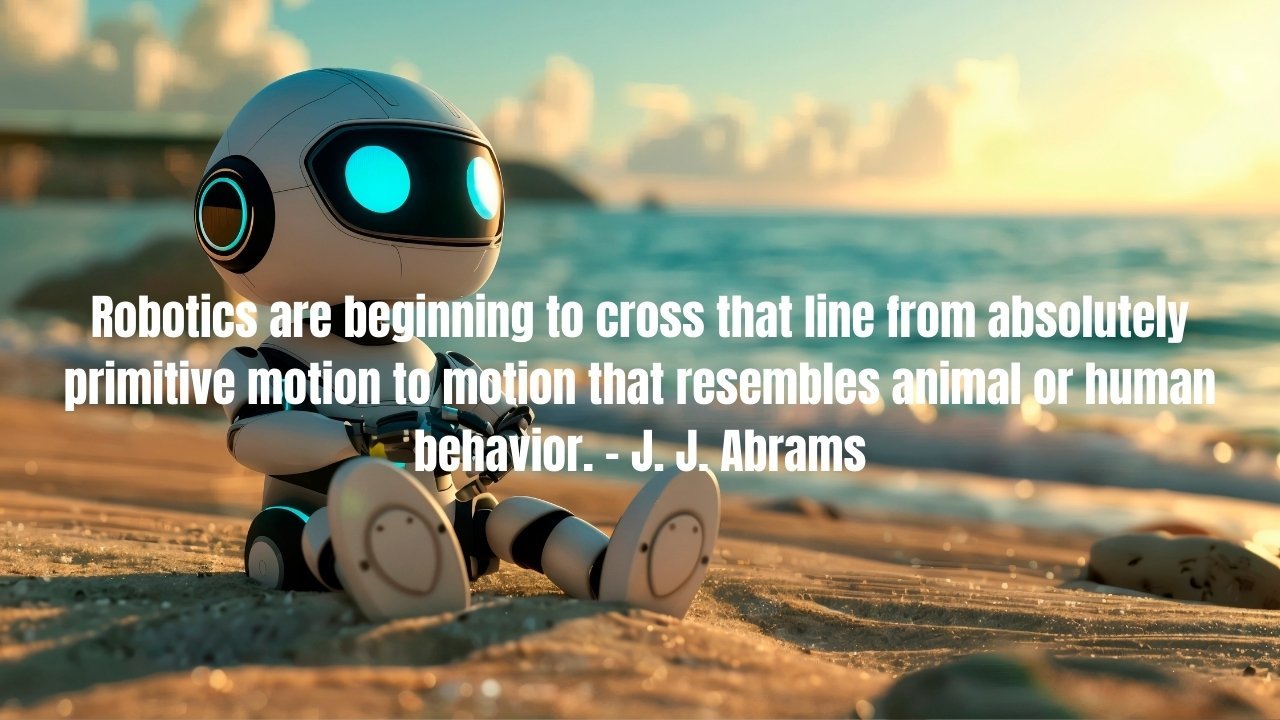
J.J. Abrams notes that robotics are crossing a critical threshold. Autonomous robots now move in ways that resemble living creatures rather than mechanical devices. This advancement in human-robot interaction changes everything about how we perceive robotic systems.
Bill Gates sees robotics and related technologies making the world dramatically better. The combination of artificial intelligence, automation, and machine learning will create possibilities we can barely imagine today.
“Robotics are beginning to cross that line from absolutely primitive motion to motion that resembles animal or human behavior. – J. J. Abrams”
“Robotics and other combinations will make the world pretty fantastic compared with today. – Bill Gates”
Emily Berrington raises an important question about ethics of robotics. If robots can have responsibilities in society, shouldn’t they also have rights of robots? This philosophical challenge will shape robotics regulation in coming decades.
The military robotics debate demands attention. Peter Singer warns that history will judge us harshly if we ignore armed autonomous robotics issues. Just because something sounds like science fiction doesn’t mean we can avoid addressing it.
“If something robotic can have responsibilities, then it should also have rights. – Emily Berrington”
“History is not going to look kindly on us if we just keep our head in the sand on armed autonomous robotics issue because it sounds too science fiction. – Peter Singer”
Colin Angle, a pioneer in robotics manufacturing, explains how the robotics market will evolve. Instead of one general-purpose robot, homes will have multiple special-purpose robots. Each service robot will excel at specific tasks.
The technological frontiers of robotics involve three key areas. Navigation systems, manipulation abilities, and artificial intelligence form the foundation. When a robot truly understands “go to the kitchen,” that represents a breakthrough in robotics applications.
“The way that the robotics market is going to grow, at least in the home, is that we’ll have a number of different special purpose robots. – Colin Angle”
“The answer is navigation, manipulation, and implementation of more sophisticated intelligence. The idea that a robot will become more aware of its environment, that telling it to ‘go to the kitchen’ means something – navigation and understanding of the environment is a robot problem. Those are the technological frontiers of the robotics industry. – Colin Angle”
The robotics industry struggled for years because engineers chased cool but difficult projects. Colin Angle emphasizes that robotics innovation succeeds when it solves actual human problems. Focus keeps robot technology affordable and practical.
Martin Rees envisions robotic exploration throughout our solar system. By 2050, tiny robotic spacecraft could map every planet and moon. Space robotics makes exploration safer and more cost-effective than human missions.
“The reason it has taken so long for the robotics industry to move forward is because people keep trying to make something that is cool but difficult to achieve rather than trying to find solutions to actual human problems. Technology can be extremely expensive if you don’t focus. – Colin Angle”
“I hope that by 2050 the entire solar system will have been explored and mapped by flotillas of tiny robotic craft. – Martin Rees”
Bob Reiner captures the limitless potential of robotics. Our imagination is the only boundary to what robotic systems might achieve. This optimism drives robotics research forward every day.
Cynthia Breazeal, an expert in human-robot collaboration, reframes the entire field. Robotics isn’t about creating servants. It’s about building partners that work alongside humans, enhancing our capabilities rather than replacing us.
“In the field of robotics, the future is limited only by our imagination. – Bob Reiner”
“Robotics is not about making machines to serve us. It’s about creating machines that can be our partners. – Cynthia Breazeal”
Isaac Asimov’s famous laws of robotics still influence how we think about ethics of robotics. The first law establishes that robots must never harm humans. This principle guides robotics engineering and artificial intelligence development today.
The complete Three Laws of Robotics provide a moral framework. Robots must protect humans first, obey orders second, and preserve themselves third. The Zeroth Law adds that robots must protect humanity as a whole.
“A robot may not injure a human being, or, through inaction, allow a human being to come to harm. – Isaac Asimov”
“The Three Laws of Robotics: 1: A robot may not injure a human being or, through inaction, allow a human being to come to harm; 2: A robot must obey the orders given it by human beings except where such orders would conflict with the First Law; 3: A robot must protect its own existence as long as such protection does not conflict with the First or Second Law; The Zeroth Law: A robot may not harm humanity, or, by inaction, allow humanity to come to harm. – Isaac Asimov”
“A robot must protect its own existence as long as such protection does not conflict with the First or Second Laws. – Isaac Asimov”
Robotics and Human Collaboration Quotes
Human-robot collaboration represents the next frontier in robotics applications. These quotes explore how robots and people can work together, creating partnerships that amplify human abilities while respecting our unique qualities. if you want to read about Paul Wellstone Quotes than visit this page.
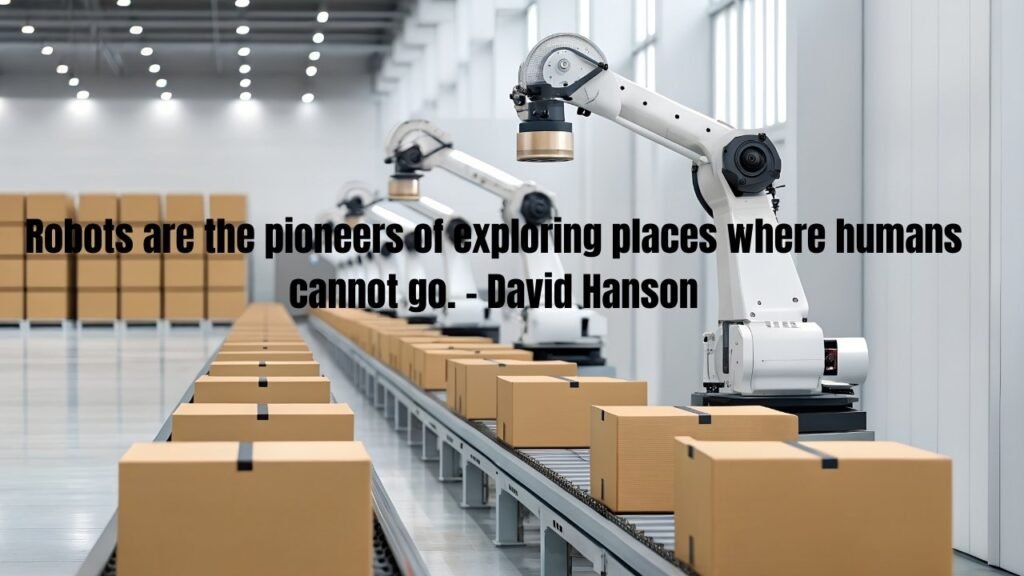
David Hanson sees robots as pioneers exploring places humans cannot reach. Robotic exploration opens up dangerous environments, from deep oceans to distant planets. Autonomous robots go where we physically cannot survive.
Ayanna Howard calls robotic engineers modern magicians. They bring lifeless metal and circuits to life through robotics engineering. This creative process transforms raw materials into intelligent machines that move and think. if you want to read Guido Sarducci Quotes than visit this page.
“Robots are the pioneers of exploring places where humans cannot go. – David Hanson”
“Robotic engineers are modern-day magicians, bringing inanimate objects to life. – Ayanna Howard”
Rodney Brooks views robotics as more than science. The robotics field serves as a canvas for artistic expression, innovation culture, and human progress. Robot technology combines technical skill with creative vision.
Raffaello D’Andrea redirects our focus from machines to relationships. Robotics centers on creating companion robots that enhance what humans can do. Service robots should make people more capable, not obsolete.
“Robotics is not just a field of science; it’s a canvas for art, innovation, and progress. – Rodney Brooks”
“Robotics isn’t about machines; it’s about creating companions that enhance human capabilities. – Raffaello D’Andrea”
Hiroshi Ishiguro reminds us where true innovation comes from. Robots may be built from steel and silicon, but the soul of robotics lies in human creativity. Robotic engineers infuse their creations with purpose and personality.
Ellen Ochoa describes the teamwork required for space robotics. Operating robotic arms on spacecraft demands coordination between multiple people. Human-robot interaction in space exemplifies perfect collaboration.
“Machines may be made of steel and silicon, but the soul of robotics is in the creativity of its creators. – Hiroshi Ishiguro”
“It’s fun to work the robotic arm in part because it’s really a team effort. – Ellen Ochoa”
Jennifer Granholm highlights how automation has transformed transportation. Modern cars contain more advanced robot technology than most computers. Thousands of parts work together through sophisticated robotic systems.
Riane Eisler challenges us to redefine productive work. As automation, robotics, and artificial intelligence replace traditional jobs, society must rethink what it means to contribute. The future of work requires new definitions of value.
“There’s more technology in your car than there is in your computer. It’s got thousands of parts in it. It’s extremely sophisticated, all that robotics. – Jennifer Granholm”
“We are rapidly moving into the post-industrial age, when we must redefine what is ‘productive’ work, as more and more jobs are being replaced by automation, robotics, and artificial intelligence. – Riane Eisler”
William Westney warns against robotic rigidity in human performance. Whether in music or other arts, people want authenticity. Pure mechanical perfection without emotion fails to connect with audiences.
Jose Padilha connects robotics to political movements. The relationship between authoritarianism and autonomous systems will grow more important. How societies govern robot technology reveals their values and priorities.
“Robotic correctness is the last thing judges want to see or hear. – William Westney”
“The relationship between fascism and robotics, for instance, it’s very clear that it’s going to become way more important as time goes by. – Jose Padilha”
Lee Westwood notes how golf requires mental balance. Players cannot afford to be too robotic in their thinking. The psychological aspects of competition demand flexibility and human emotion.
John Glenn advocates for strategic robotic exploration before human missions. Robotic rovers and probes should gather maximum information first. Only after robots have done their work should astronauts follow to continue research.
“People always say golfers don’t smile. But there is so much psychology in golf, so we have to be a bit robotic. – Lee Westwood”
“I think sometime we will go to Mars and I think we’ll explore it with humans sometime, but I think it’s really wise to do all the robotic exploration ahead of time and learn as much as possible. Once we have learned as much as possible with the robots, then that’s the time to send people, and let them then continue the research that the robots have started. – John Glenn”
Peter Diamandis describes the democratization of power through technology. Small groups now wield capabilities once reserved for nations. Artificial intelligence, robotics, nanotechnology, and networks empower individuals at unprecedented scales.
Robert Anton Wilson offers a unique perspective on intelligence. He contrasts true understanding with robotic thinking. Rigid belief systems block our ability to receive, decode, and share information effectively.
“Today, a group of 20 individuals empowered by the exponential growing technologies of AI and robotics and computers and networks and eventually nanotechnology can do what only nation states could have done before. – Peter Diamandis”
“Intelligence is the capacity to receive, decode and transmit information efficiently. Stupidity is blockage of this process at any point. Bigotry, ideologies etc. block the ability to receive; robotic reality-tunnels block the ability to decode or integrate new signals; censorship blocks transmission. – Robert Anton Wilson”
Umberto Guidoni explains technical aspects of space robotics. During spacewalks, repositioning power systems allows robotic arms to be fully controlled from the space station lab. This human-robot collaboration enables complex orbital operations.
J.B. Smoove rejects robotic performances in entertainment. Every live show should feel fresh and unique for each audience. Spontaneity and human connection matter more than mechanical consistency.
“During that space walk there will be some repositioning of the power so that the arm can be fully controlled by the robotic station that is in the Lab. – Umberto Guidoni”
“Man, you can come see me six or seven times in a row and you’ll never see the same show twice, because I don’t like to be robotic onstage. I like to perform for that particular audience. – J. B. Smoove”
Ethical and Safety Concerns in Robotics
The ethics of robotics raises profound questions about technological responsibility and the future of humanity. As robots become more capable, society must address safety, morality, and the proper relationship between humans and intelligent machines.
Buzz Aldrin predicts robotics will dominate lunar operations. The most critical decision for space exploration involves committing to permanent human presence on Mars. Without Mars colonization, humanity will never truly become a spacefaring species.
Ben Zimmer observes how public figures struggle with authenticity. When leaders appear robotic or artificially emotional, it undermines trust. Genuine human connection cannot be successfully faked through mechanical rehearsal.
“Long-term, I see robotics prevailing on the moon. The most important decision we’ll have to make about space travel is whether to commit to a permanent human presence on Mars. Without it, we’ll never be a true space-faring people. – Buzz Aldrin”
“Hillary Clinton has been portrayed as robotic, someone who is trying to approximate real human emotion. – Ben Zimmer”
Hod Lipson describes a revolutionary shift in manufacturing automation. When producing advanced robotic parts costs the same as making paperweights, the economics of production transform completely. This changes what’s possible in robotics manufacturing.
Jason Silva sees robotic augmentation helping people with disabilities. Before we even reach organ printing and synthetic biology, exoskeletons and robotic limbs will dramatically improve mobility for millions of Americans.
“When it costs you the same amount of manufacturing effort to make advanced robotic parts as it does to manufacture a paperweight, that really changes things in a profound way. – Hod Lipson”
“I think people who have all kinds of debilitating mobility issues will benefit from robotic augmentation. That is even before we get into organ replacement and organ printing and synthetic biology and so on and so forth. – Jason Silva”
Neil deGrasse Tyson explains the appeal of robotic exploration. Robots survive harsh conditions, explore dangerous environments, and never need return trips. They accomplish missions impossible for human astronauts while eliminating safety risks.
Mary Norris reflects on unfulfilled robotics predictions. Instead of commanding robot servants, we’ve integrated technology into ourselves. Smartphones and devices function as external organs, making us cyborgs rather than robot owners.
“People are really excited about robotic exploration. I understand the feeling there because, in fact, robots can do things humans can’t. They can survive harsh conditions, they can explore places we would never go, plus you never actually have to bring them back. – Neil deGrasse Tyson”
“Back in the twentieth century, we thought that robots would have taken over by this time, and, in a way, they have. But robots as a race have proved disappointing. Instead of getting to boss around underlings made of steel and plastic with circuitry and blinking lights and tank treads, like Rosie the maid on The Jetsons, we humans have outfitted ourselves with robotic external organs. Our iPods dictate what we listen to next, gadgets in our cars tell us which way to go, and smartphones finish our sentences for us. We have become our own robots. – Mary Norris”
Ken Jennings uses humor to address cyborg distinctions. The line between robot and human blurs when mechanical frames contain organic parts. This raises questions about identity and what makes us human.
Naveen Jain wants to democratize lunar exploration. By sending robotic rovers instead of humans, Moon Express can search for valuable minerals while making space accessible to ordinary people, not just governments.
“We regret the insinuation that Mr. Alex Trebek is a robot, and has been since 2004. Mr. Trebek’s robotic frame does still contain some organic parts, many harvested from patriotic Canadian schoolchildren, so this technically makes him a ‘cyborg,’ not a ‘robot.’ – Ken Jennings”
“When I finally had the chance to make my childhood dream a reality – as a co-founder and chairman of Moon Express – my goal was to broaden participation in lunar exploration, and connect the common person to its results. We plan to send robotic rovers – not humans – to the Moon to search for precious metals and rare minerals on the Moon’s surface. – Naveen Jain”
Neal Bascomb finds deeper meaning in robotics competitions. Beyond sports and engineering, these contests reveal human creativity and problem-solving. Robotics programs teach skills that transcend technical knowledge.
James Van Allen questions human space exploration priorities. When weighing costs and benefits, only adventure justifies continued human spaceflight. For most Americans, the experience remains vicarious, like watching science fiction movies.
“While The New Cool takes the reader inside a season, limns a team and coaching staff, and masterfully recounts a gripping competition, this is anything but your conventional sports book. And not simply because the ‘big game’ is…a curious robotics contest. Like the kids he vividly captures, Neal Bascomb has himself performed a masterful bit of engineering here. – L. Jon Wertheim”
“In a dispassionate comparison of the relative values of human and robotic spaceflight, the only surviving motivation for continuing human spaceflight is the ideology of adventure. But only a tiny number of Earth’s six billion inhabitants are direct participants. For the rest of us, the adventure is vicarious and akin to that of watching a science fiction movie. At the end of the day, I ask myself whether the huge national commitment of technical talent to human spaceflight and the ever-present potential for the loss of precious human life are really justifiable. – James Van Allen”
Michael Light cares more about context than authorship. Whether astronauts, robotic cameras, or military photographers capture images matters less than the meaning those photographs generate. Content trumps creator.
Chris Hardwick challenges stereotypes about bowling. The sport employs heavy technology including robotic pinsetters and computerized scoring. This represents just the beginning of automation in recreational activities.
“I don’t particularly care about photographic authorship. Whether an astronaut who doesn’t even have a viewfinder makes an image, a robotic camera, a military photographer, or Mike Light really doesn’t matter. What matters is the context of the final photograph and the meaning it generates within that context. – Michael Light”
“While the liberal media elite depict the bowler as a chubby guy with a comb-over and polyester pants, the reality is that bowling is one of the most tech-heavy sports today. Robotic pinsetters and computerized scoring were just the beginning. – Chris Hardwick”
Henry Giroux criticizes educational standardization. When testing dominates schools, teachers become robotic technicians rather than educators. This approach eliminates critical thinking and judgment in American classrooms.
Malaika Arora Khan expresses interest in dance styles that mimic robotics. Popping, locking, and robotic movements demonstrate how human performers can emulate mechanical precision while maintaining artistic expression.
“Today, in the age of standardized testing, thinking and acting, reason and judgment have been thrown out the window just as teachers are increasingly being deskilled and forced to act as semi-robotic technicians good for little more than teaching for the test. – Henry Giroux”
“I would love to learn popping, locking and robotics, gymnastics and acrobatics; it is amazing to learn these things. – Malaika Arora Khan”
Michio Kaku predicts aliens might use robotic probes. Rather than flying saucers, extraterrestrials could send tiny self-replicating robots traveling at near light speed. These autonomous probes might already be here, unnoticed on our lawns.
Michael J. Massimino began his astronaut career through robotics. At MIT, he studied human-robot collaboration in space applications. This foundation prepared him for operating robotic systems during actual space missions.
“Chances are, the aliens will not want to land on our backyard, or even the White House lawn, with their flying saucers. They may have tiny, robotic self-replicating probes which can reach near light speed and can proliferate around the galaxy. So instead of the Enterprise and huge star ships, the aliens might actually send tiny probes to explore the universe. One might land on our lawn and we won’t even know. – Michio Kaku”
“My odyssey to become an astronaut kind of started in grad school, and I was working, up at MIT, in space robotics-related work; human and robot working together. – Michael J. Massimino”
Robotics Innovation and Technology Quotes
Robotics innovation drives progress across every industry. These quotes reveal how robotic engineers, researchers, and entrepreneurs push technological frontiers to create smarter, more capable intelligent machines.
Peter Singer addresses reluctance to discuss military robotics. Defense experts often dismiss armed autonomous robotics as science fiction. But these weapons already exist as hard reality, not fantasy.
Marc Garneau recalls Canada’s contribution to space robotics. NASA invited Canadian payload specialists because of the innovative robotic arm used on space shuttles. This human-robot collaboration became essential for orbital operations.
“In my world of the people who study war and defense issues, we simply did not talk about robotics. We do not talk about it because it’s seen as mere science fiction. It’s cold, hard, metallic reality. – Peter Singer”
“In 1983, NASA invited Canada to fly three payload specialists, in part because we had contributed the robotic arm that is used on the shuttle. – Marc Garneau”
Linda M. Godwin describes her role as robotic arm operator. This specialized position requires extensive training in human-robot interaction and precise control of complex robotic systems in zero gravity.
M.I.A. warns against treating artists like commodities. When creativity becomes purely business, it produces robotic output lacking soul. The commercialization of art removes the humanity that makes it meaningful.
“I’ll be the person using the shuttle robotic arm. – Linda M. Godwin”
“The consequence of making it a business thing and making an artist the same as a Wall Street trader is that you do get a robot by the end of it. It becomes more robotic as opposed to being more soulful. – M.I.A.”
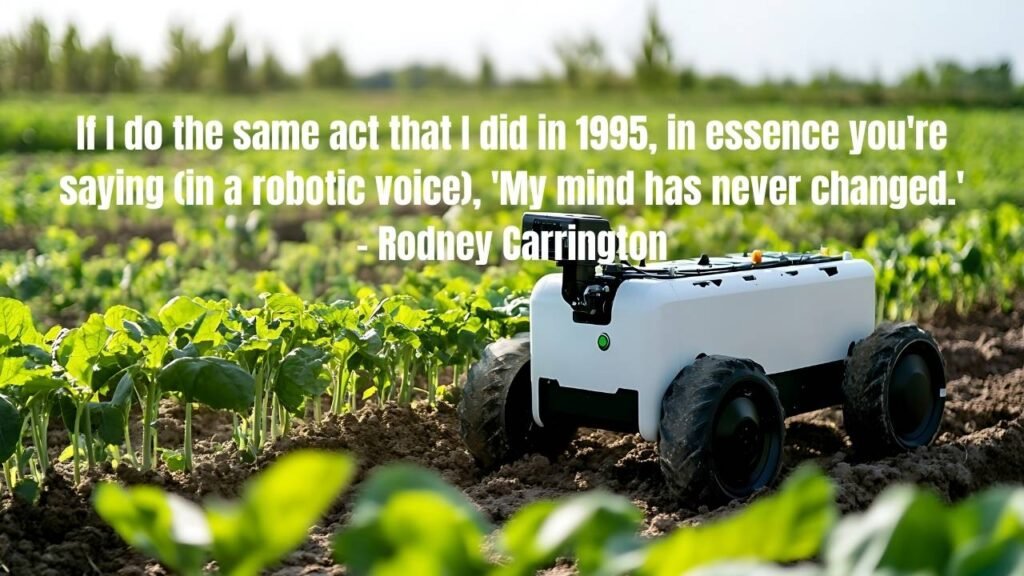
Rodney Carrington rejects intellectual stagnation. Performing the same act for decades suggests unchanging opinions. Growth requires evolving beyond robotic repetition of past ideas.
Peter Thiel questions technology optimism. Progress in robotics, artificial intelligence, nanotechnology, and pharmaceuticals falls short of expectations. Understanding why advancement lags matters for future technology development.
“If I do the same act that I did in 1995, in essence you’re saying (in a robotic voice), ‘My mind has never changed.’ – Rodney Carrington”
“People don’t want to believe that technology is broken. Pharmaceuticals, robotics, artificial intelligence, nanotechnology – all these areas where the progress has been a lot more limited than people think. And the question is why. – Peter Thiel”
Robin Williams humorously illustrates technology limitations. His iPhone’s Siri couldn’t provide French restaurant recommendations, highlighting how artificial intelligence still struggles with simple tasks in certain contexts.
Juan Enriquez celebrates expanding career options. Students can now work in genomics, proteomics, robotics, or fields that don’t yet exist. The digital economy creates new industries faster than colleges can teach them.
“I’m fascinated by the new iPhone. I bought it and kept trying to use it in France. ‘Siri, what is a good restaurant?’ (In a robotic voice.) ‘I’m sorry, Robin. I can’t give locations in France.’ ‘Why, Siri?’ ‘I don’t know.’ It’s like she was upset with the French or something. ‘They seem to have an attitude I can’t understand. Should I look for Germans, Robin?’ – Robin Williams”
“There has to be some more regulation. But our kids have this incredible buffet of they can work in genomics, they can work in pre-omics, or they can work in robotics, or they can work in this, or they can work in that. And within the next five years there will be entirely new industries that come out of nowhere that kids are working in that would have been inconceivable when they started college. Not when we started college. – Juan Enriquez”
James Dyson explains why most robotic vacuum cleaners fail. They lack vision, proper suction, and cleaning effectiveness. His company developed 360-degree computer vision combined with powerful motors to create genuine labor-saving home robots.
Greg Laurie encourages compassionate faith sharing. Religious discussions should never feel robotic or mechanical. Listening to people and responding thoughtfully matters more than following scripts.
“Most robotic vacuum cleaners don’t see their environment, have little suction, and don’t clean properly. They are gimmicks. We’ve been developing a unique 360 vision system that lets our robot see where it is, where it has been, and where it is yet to clean. Vision, combined with our high speed digital motor and cyclone technology, is the key to achieving a high performing robot vacuum – a genuine labor saving device. – James Dyson”
“I appreciate zeal and energy and passion but in our zeal, we just need to do it in a loving way and do it in a compassionate way, not share our faith in a robotic or mechanical way, but interact with the person, listen to them, and respond appropriately to their questions. – Greg Laurie”
Alan Parsons honors Isaac Asimov’s influence. Though his album didn’t directly adapt Asimov’s work, it explored the power of robotics as a concept. Asimov’s vision continues inspiring artists across disciplines.
James Cameron combines robotics with investigative journalism. He’s piloted robotic vehicles over 50 hours at the Titanic wreck site, using forensic analysis to understand the disaster. Documentary filmmaking becomes his new passion.
“I had the honor of speaking with Asimov. The album ended up being something not directly related to Asimov, but related instead to the concept of the power of robotics. – Alan Parsons”
“I’m a curious guy. I can’t turn away from an investigative story, when it comes to the forensic analysis. I’ve done 33 dives, to the Titanic wreck site. I’ve spent over 50 hours piloting robotic vehicles at that wreck trying to piece together what happened during the disaster. How the ship broke up, comparing the historical record with the forensic record. Documentaries are kind of my new life. I love documentary filmmaking. – James Cameron”
David A. Aaker defines branding’s essential role. Without spirit and soul, products become robotic price-value propositions. Humans create meaning, and artificial intelligence alone cannot replace authentic human connection.
Robert Harris champions tape for data archiving. Reliable and affordable, tape storage excels in large-scale robotic systems managing petabytes of information. Sometimes older technology serves specific needs better than cutting-edge alternatives.
“Branding adds spirit and a soul to what would otherwise be a robotic, automated, generic price-value proposition. If branding is ultimately about the creation of human meaning, it follows logically that it is the humans who must ultimately provide it. – David A. Aaker”
“Tape is the archiving champ and has been for decades. Reliable, less expensive than disks and available in large-scale robotic systems that store petabytes. – Robert Harris”
Robotics in Space Exploration
Space robotics enables humanity to explore beyond Earth’s boundaries. Robotic spacecraft, rovers, and probes venture where humans cannot survive, gathering data that expands our understanding of the universe.
Madonna Ciccone rejects robotic thinking for herself and her children. Questioning conventions and challenging systems remains important even as a parent. Critical thinking should never become automated or mechanical.
Nolan Bushnell describes his diverse career path. Moving between navigation systems, robotics, restaurants, and communications reflects creative curiosity. His “five-year attention span” drives innovation culture across industries.
“Obviously, my tastes and my priorities have changed. But I’m still asking the question ‘Why?’ Just because I’m a mother doesn’t mean I’m not still a rebel and that I don’t want to go in the face of convention and challenge the system. I never wanted to think in a robotic way, and I don’t want my children to think that way, either. – Madonna Ciccone”
“I’ve been in navigation systems, robotics, restaurants, communications systems, touch screens, and now I’m back in games. I like to say I have five-year A.D.D. – Nolan Bushnell”
Jason Beghe criticizes how organizations can manipulate thinking. Creating robotic versions of people through psychological conditioning removes authentic personality. True communication requires independent thought, not programmed responses.
Daley Thompson values emotional performance in athletics. Athletes today often seem too robotic in their presentation. His career focused on entertainment and differentiation, not mechanical perfection.
“Scientology delivers what it promises under the guise of tearing away falsity, neuroses, psychoses. It creates a brainwashed, robotic version of you. It’s a ‘Matrix’ of you, so you’re communicating with people all the time using Scientology. – Jason Beghe”
“Athletes these days are too robotic. People like to see performances filled with emotion. In my career I tried to be amusing, to differentiate myself from the other champions. – Daley Thompson”
Peter Singer emphasizes cross-disciplinary dialogue about military robotics. Scientists alone cannot address armed autonomous robotics. Political scientists must join the conversation to avoid repeating atomic bomb mistakes.
Weapons development sometimes reverses course. We’ve pulled back from biological and chemical weapons. Armed autonomous robotics might face similar restrictions as society recognizes their dangers.
“My fear is that that’s what’s going to happen with robotics and the military. Importantly, this discussion has to involve not just the scientists, but also the political scientists. It’s got to be a multidisciplinary discussion. You can’t have it be another repeat of what happened with the people working on the atomic bomb. – Peter Singer”
“There are a lot of weapons that we’ve developed which we’ve pulled back from – biological weapons, chemical weapons, etc. This may be the case with armed autonomous robotics, where we ultimately pull back from them. – Peter Singer”
Colin Angle recalls connecting robots to the Internet. In the late 1990s, this breakthrough enabled remote operation of robots. iRobot pioneered hiring operators as rented brains for robotic systems.
Oren Etzioni predicts job automation will increasingly affect American workers. Advances in automation, artificial intelligence, and robotics will eliminate traditional employment faster than new jobs appear.
“Around the late 1990s, I’d become convinced that one of the killer applications of robotics came from connecting robots to the Internet. The idea of solving generalized artificial intelligence was still far away, but heck, I could rent brains by hiring operators. iRobot was the name of the company and one of our most ambitious projects, iRobot LE. – Colin Angle”
“Sooner or later, the U.S. will face mounting job losses due to advances in automation, artificial intelligence, and robotics. – Oren Etzioni”
Mark Cuban supports different minimum wages by sector. Retail and food service need $12 minimum wage. But manufacturing automation through robotics and software will revolutionize production. American factories must stay competitive globally.
Anthony Levandowski sees robotics competitions as beginnings rather than endpoints. Grand challenges launch adventures in autonomous systems development. Each milestone opens new possibilities for robot technology.
“For food service industry and retail, I’m for the minimum wage being increased to at least $12. Not for manufacturing. Software and robotics are going to revolutionize manufacturing in the next 10 years. In the meantime, we have to compete with overseas manufacturing. – Mark Cuban”
“I see Grand Challenge not as the end of the robotics adventure we’re on: it’s almost like the beginning. – Anthony Levandowski”
Pierre Nanterme identifies global robotics innovation sources. Strong developments in automation, robotics, cognitive computing, and artificial intelligence increasingly come from the Philippines and India, not just traditional tech centers.
Jensen Huang envisions artificial intelligence engaging the physical world. Through robotics, drones, and autonomous devices, the Internet will directly interact with reality. Smart machines will operate independently with increasing sophistication.
“When I think about strong innovations in terms of automation, robotics, cognitive computing, and artificial intelligence, they are coming a lot from the Philippines and from India as well. – Pierre Nanterme”
“A.I. will make it possible for the Internet to directly engage people in the real world, through robotics and drones and little machines that will do smart things by themselves. – Jensen Huang”
David Hanson warns about robots designed for killing. These machines lack empathy entirely. He advocates for character robotics that could develop genuine empathy, potentially offering hope for humanity’s future relationship with intelligent machines.
Miguel Nicolelis describes groundbreaking work with exoskeletons. Brain-controlled robotic devices that provide feedback to patients represent unprecedented achievement. Demonstrating this technology in stadiums pushes robotics research into public consciousness.
“Machines are becoming devastatingly capable of things like killing. Those machines have no place for empathy. There’s billions of dollars being spent on that. Character robotics could plant the seed for robots that actually have empathy. – David Hanson”
“It’s the first time an exoskeleton has been controlled by brain activity and offered feedback to the patients. Doing a demonstration in a stadium is something very much outside our routine in robotics. It’s never been done before. – Miguel Nicolelis”
Rodney Brooks notes robotics requires diverse knowledge. Few colleges offer majors perfectly fitted to robotics education. The interdisciplinary science demands expertise across multiple fields, making specialized degrees rare in American universities.
Michael Spence tracks robotics expansion into new industries. Electronics assembly already uses extensive factory robots. Sewing trades will likely adopt automation next, affecting countries’ entry into global manufacturing.
“Robotics is very interdisciplinary, and so, except at a very few colleges, there is not a major that is exactly fitted to robotics. – Rodney Brooks”
“Robotics has already made significant inroads in electronics assembly, with sewing trades—traditionally many countries’ first entry point to the global trading system—likely to come next. – Michael Spence”
Artificial Intelligence and Robotics Quotes
Artificial intelligence and robotics increasingly overlap, creating intelligent machines that think and act. These quotes explore how AI, machine learning, and cognitive computing transform what robots can accomplish.
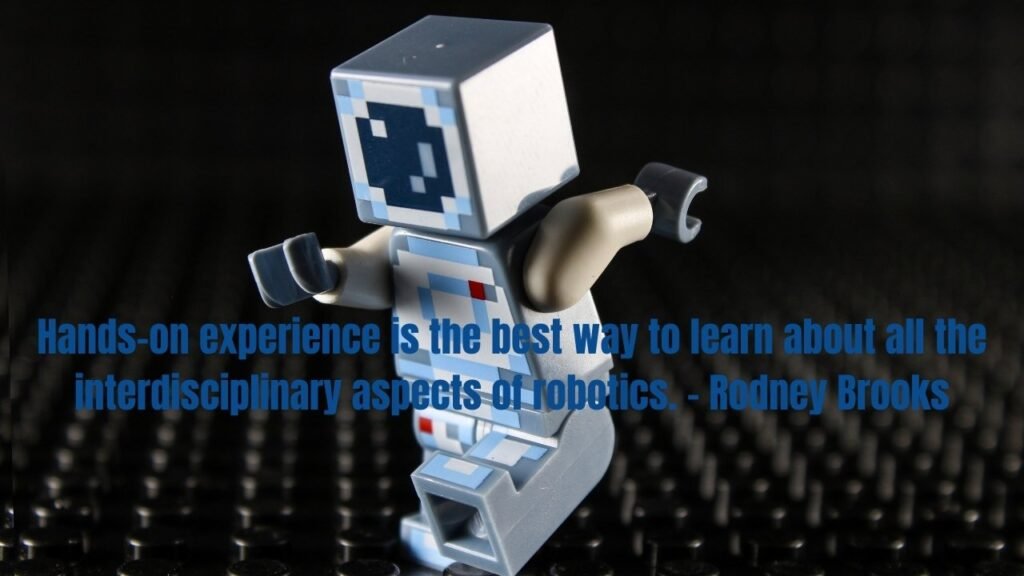
Rodney Brooks advocates hands-on learning in robotics. Direct experience provides the best way to understand interdisciplinary aspects of building robots. Theory matters, but practical work drives real comprehension of robotic systems.
Pierre Nanterme describes how new technology enables modern work. Automation, robotics, and intelligent platforms increasingly power professional activities. This technological responsibility reshapes every industry.
“Hands-on experience is the best way to learn about all the interdisciplinary aspects of robotics. – Rodney Brooks”
“Increasingly, the work we do is enabled more and more by new IT, including automation, robotics, and intelligent platforms. – Pierre Nanterme”
Mohammad bin Salman envisions building innovative cities from scratch. Neom will be drone-friendly and centered on robotics development. This ambitious project aims to create extraordinary environments for dreamers and inventors.
Steve Mollenkopf sees convergence accelerating progress. Billions of mobile devices unite with robotics, artificial intelligence, and nanotechnology. This combination of technologies creates unprecedented opportunities for innovation.
“We will build the city from scratch. It will be drone-friendly and a center for the development of robotics. We want to create something different. Neom is a place for dreamers who want to create something new in the world, something extraordinary. – Mohammad bin Salman”
“Today, billions of mobile devices with extraordinary power are uniting with advancements in robotics, artificial intelligence, nanotechnology, and so much more. – Steve Mollenkopf”
Andy Weir questions human Mars exploration necessity. Well-designed rovers can accomplish nearly everything astronauts could do on Mars. Advanced computer and robotics technology makes human missions less essential for scientific data collection.
Rick Tumlinson argues frontier challenges accelerate progress. Opening new frontiers pushes robotics, manufacturing, medicine, farming, and energy beyond limits. This advancement raises humanity’s odds of long-term survival.
“Back in the days of Apollo, sending humans to the moon was the only viable way to get the scientific data we wanted. But now, with our computer and robotics technology, there’s very little an astronaut can do on Mars that a well-designed rover can’t. – Andy Weir”
“Robotics, manufacturing, medicine, farming, energy—all will be pushed to and beyond their limits and, by so doing, will advance at speeds far faster than without the impetus and challenge of opening a frontier—thus also raising the odds of survival in our favor. – Rick Tumlinson”
Charles Best connects classroom resources to student dreams. Without books, microscopes, and robotics kits, students cannot dream big. Basic supplies like paper and pencils remain essential for STEM education.
Daniel H. Wilson weaves personal experience into fiction. The IP address in his book traces back to Carnegie Mellon’s Robotics Institute, where he studied. This detail grounds science fiction in real robotics research institutions.
“Students can’t dream big when classrooms lack books, microscopes, and robotics kits—or even paper, pencils, and paste. – Charles Best”
“There are no movie references that I can think of in ‘Robopocalypse.’ However, there are tons of personal references. For example, the IP address that Lurker tracks actually goes back to the Robotics Institute at Carnegie Mellon University, where I studied robotics. – Daniel H. Wilson”
Adam Ostrow predicts technology will recreate us digitally. The content we create, combined with machine learning, robotics, and big data analytics, could produce realistic representations of individuals. Our digital footprints may outlive us.
David Hanson dismisses criticism of realistic robots. Nobody complains about Bernini’s sculptures or Rockwell’s paintings being too real. Robots can be realistic and loved too. His goal is creating new art from robotics.
“Ultimately, I hypothesize that technology will one day be able to recreate a realistic representation of us as a result of the plethora of content we’re creating converging with other advances in machine learning, robotics, and large-scale data mining. – Adam Ostrow”
“Nobody complains that Bernini’s sculptures are too darn real, right? Or that Norman Rockwell’s paintings are too creepy. Well, robots can seem real and be loved, too. We’re trying to make a new art medium out of robotics. – David Hanson”
Rhianna Pratchett credits her father’s influence on her career. His work with electronics, robotics, and computers sparked her interest. Family exposure to technology shapes career paths for many in the robotics field.
Colin Angle criticizes unnecessary robotics applications. Google didn’t need robot cars to create Street View. Using walking robots to push vacuum cleaners represents gratuitous robotics rather than solving real problems.
“Dad was very into electronics, robotics and computers, so I was interested in what he was doing. – Rhianna Pratchett”
“Did Google need to make robot cars in order to make Streetview work? Absolutely not. It’s the equivalent of saying you need a walking robot in order to push an upright vacuum cleaner. It’s gratuitous robotics! – Colin Angle”
Rodney Brooks founded Rethink Robotics to democratize factory robots. Their machines can be trained by anyone in minutes. This accessibility transforms manufacturing automation by eliminating complex programming requirements.
Mark Frauenfelder profiles innovative companies like Evil Mad Scientist Laboratories. They’ve designed specialized electronics and robotics kits since 2007. These resources help hobbyists and students explore robotics engineering independently.
“In 2008, I decided I wanted to begin a new venture, so I started Rethink Robotics. We build factory robots that a person can learn to train in just a few minutes. In May 2011, I stepped off the iRobot board. – Rodney Brooks”
“Windell Oskay is the co-founder of Evil Mad Scientist Laboratories, a Silicon Valley company that has designed and produced specialized electronics and robotics kits since 2007. – Mark Frauenfelder”
Asa Hutchinson emphasizes programming skills for manufacturing. Whether examining manufacturing or knowledge industries, they all need computer programmers. Robotics applications across sectors require coding expertise.
Julie Sweet describes how innovation hubs focus on local industries. In Houston, the hub concentrates on energy sector clients, robotics, and automation. Regional specialization drives targeted robotics innovation.
“Whether you’re looking at manufacturing and the use of robotics or the knowledge industries, they need computer programmers. – Asa Hutchinson”
“Innovation hubs are going to be in cities focused on the industries and clients of that city. So in Houston, it’s focused on our industrial companies, particularly the energy sector, robotics, and automation. – Julie Sweet”
Tae Yoo sees technology accelerating humanitarian relief. Aerial robotics and big data analytics enable faster, more efficient responses. Technology reaches more people sooner and more cost-effectively, ultimately saving lives.
Pierre Nanterme invests in upskilling workers. His company proactively trains thousands in cloud, artificial intelligence, and robotics. Preparing the workforce for future technology prevents workforce displacement.
“From aerial robotics to big data analytics, technology presents the opportunity to expedite and magnify the impact of humanitarian relief efforts through greater efficiency and responsiveness: reaching more people, sooner, more cost-effectively, and saving more lives. – Tae Yoo”
“We are proactively training and upscaling thousands of people in key areas such as cloud, artificial intelligence, and robotics. – Pierre Nanterme”
Robotics Impact on Jobs and Economy
The impact of robotics on employment and economics shapes America’s future. Understanding how automation, job automation, and intelligent machines affect work helps society prepare for economic transformation.
Travis Kalanick connects self-driving technology to robotics. When cars become autonomous, transportation companies transform into robotics firms. Automation fundamentally changes business models and industry definitions.
Jensen Huang considers his work near science fiction realization. Virtual reality, artificial intelligence, and robotics research brings imagined futures into reality. The line between fiction and fact increasingly blurs in technology.
“When you start to automate, you start to do the self-driving thing, you make it much more efficient. When these cars go into self-driving, you start to become a robotics company. – Travis Kalanick”
“Virtual reality, all the A.I. work we do, all the robotics work we do—we’re as close to realizing science fiction as it gets. – Jensen Huang”
Cynthia Breazeal observes robots entering daily life. While robots have reached deep oceans and Mars, living rooms represent the final frontier. Home robots face unique challenges compared to industrial robots or space robotics.
Sebastian Thrun chose robotics as the best path to study intelligence. Understanding how robots think and learn provides insights into cognition itself. Robotics research becomes a window into consciousness and decision-making.
“If you look at the field of robotics today, you can say robots have been in the deepest oceans, they’ve been to Mars, you know? They’ve been all these places, but they’re just now starting to come into your living room. Your living room is the final frontier for robots. – Cynthia Breazeal”
“I ultimately got into robotics because for me, it was the best way to study intelligence. – Sebastian Thrun”
Peter Diamandis highlights Chris Anderson’s pivot to robotics manufacturing. After editing Wired magazine, Anderson founded 3D Robotics to produce autonomous flying vehicles. This exemplifies how media professionals embrace robotics entrepreneurship.
Leanne Caret describes partnerships advancing maritime solutions. Liquid Robotics’ technology combined with Boeing’s intelligence capabilities helps customers address maritime challenges. Smart machines make existing platforms smarter and operations safer.
“After more than a decade as the editor of ‘Wired’ magazine, Chris Anderson started the company of his dreams—a robotics manufacturing company called 3D Robotics—to produce the autonomous flying vehicles coming out of DIY Drones. – Peter Diamandis”
“With Liquid Robotics’ innovative technology and Boeing’s leading intelligence, surveillance, and reconnaissance solutions, we are helping our customers address maritime challenges in ways that make existing platforms smarter, missions safer, and operations more efficient. – Leanne Caret”
David Hanson believes empathetic robots could save humanity. If character robotics achieves human-level or greater intelligence with empathy, this could offer hope. Machine empathy might prevent dystopian futures where robots lack compassion.
Philippe Perrin finds humor in robotic arm similarities to human anatomy. The Mobile Base System truly functions like a shoulder. Comparing the Canadian robotic arm to human arms reveals universal design principles.
“Character robotics could plant the seed for robots that actually have empathy. So, if they achieve human level intelligence or, quite possibly, greater than human levels of intelligence, this could be the seeds of hope for our future. – David Hanson”
“Yes, I see the Mobile Base System really is the shoulder of the arm. The arm is right there, like a human arm. It’s really funny to look at the similarities between a human arm and the Canadian robotics arm. – Philippe Perrin”
Michael Dell argues PCs remain essential despite mobile device popularity. 3D printing, virtual reality, and robotics all require computers for control. The digital economy still depends on traditional computing power.
Colin Angle recalls when current technologies were robotics problems. Voice recognition, image recognition, voice over IP, and touchscreens all emerged from robotics research. Today’s common features originated in robotics labs.
“The world got enamored with smartphones and tablets, but what’s interesting is those devices don’t do everything that needs to be done. Three-D printing, virtual-reality computing, robotics are all controlled by PCs. – Michael Dell”
“When I was building robots in the early 1990s, the problems of voice recognition, image understanding, VOIP, even touchscreen technologies—these were robotics problems. – Colin Angle”
Colin Angle warns against robotics hype cycles. The field has been “the next big thing” for decades. Its compelling nature leads people to get carried away with promises. Overenthusiasm historically held back the robotics industry.
Megan Smith advocates for maker education in core curriculum. Computer science, shop class, and hands-on building should be standard, not optional. Programs like First Robotics need to become mainstream in American STEM education.
“Robotics has been around forever, and it’s been the next big thing forever, and it is so exciting and compelling that it’s easy to get carried away. People almost always do, and that’s one of the things that has held back the industry. – Colin Angle”
“We need to have making, including computer science, shop, etc. as part of the core curriculum from the beginning, not just an optional afterschool thing. Things like First Robotics and all of those great programs need to become mainstream. – Megan Smith”
Scott Kelly describes astronaut life as combining multiple skills. Science, maintenance, and housekeeping fill most time. Occasionally, robotics activities or spacewalks add variety to orbital routines.
Mark Cuban frames job automation as inevitable. Countries will lose jobs to robotics—the question is which nation creates the best robotic technology. Owning the infrastructure to support robots determines economic winners.
“It’s a combination of science, maintenance, and general housekeeping. And then, occasionally, robotics activities or a spacewalk you might get to do. – Scott Kelly”
“We have to face the fact that countries are going to lose jobs to robotics. The only question that needs to be answered is which country will create and own the best robotic technology and have the infrastructure necessary to enable it. – Mark Cuban”
Daniel Lyons notes robotics represents one of many job killers. Outsourcing actually steals far more American jobs than automation. The workforce displacement conversation must address multiple factors beyond just robots.
Rana el Kaliouby participates in global ethics of robotics discussions. As part of the World Economic Forum Global Council on Robotics and AI, groups spend significant time discussing ethical practices and responsible robotics development.
“To be sure, robotics are not the only job killers out there, with outsourcing stealing far more gigs than automation. – Daniel Lyons”
“I am part of the World Economic Forum Global Council on Robotics and AI, and we spend a fair amount of our time together as a group discussing ethics, best practices, and the like. – Rana el Kaliouby”
Tim Sweeney envisions new economic models. As people lose jobs to robotics and self-driving cars, online value creation becomes essential. Virtual economies will enable exchanging goods, services, and entertainment experiences.
Jeff Dean acknowledges robotics difficulty. Making robots operate in arbitrary environments like conference rooms with obstacles remains challenging. Real-world complexity exceeds controlled manufacturing settings.
“As more and more people are automated out of the economy through robotics and self-driving cars and other technologies, there will be a way to create value for other human beings online. There will be a virtual economy for exchanging value, goods and services, entertainment experiences, and all that. – Tim Sweeney”
“I think robotics is a really hard problem – to make robots that operate in sort of arbitrary environments, like a big conference room with chairs and stuff. – Jeff Dean”
Dominic Cummings sees Brexit enabling faster robotics regulation. Outside EU jurisdiction, Britain can make quicker decisions about regulating genomics, AI, and robotics. Bureaucracy slows innovation in emerging technologies.
Shannon Walker applies space physics knowledge to practical work. Her degrees led directly to working at Johnson Space Center as a robotics flight controller. Academic training in physics translates perfectly to space robotics operations.
“In many areas, the E.U. regulates to help the worst sort of giant corporate looters defending their position against entrepreneurs. Post-Brexit Britain will be outside this jurisdiction and able to make faster and better decisions about regulating technology like genomics, AI and robotics. – Dominic Cummings”
“My degrees are in physics and space physics, and I did well enough in university that I actually started working at the Johnson Space Center in Houston, Texas, as a robotics flight controller right after college. – Shannon Walker”
Jamie Hyneman observes robotics becoming accessible. What used to require persistence now reaches broader audiences. Robotics creeps into all areas as barriers to entry drop significantly.
Jo Swinson connects robotics to social contracts. Technology can either fix or weaken the promise that hard work brings rewards. Robotics, artificial intelligence, and automation will determine whether society becomes more fair or less.
“We are seeing robotics creep into all areas and become accessible, where it used to be something tedious that only the most persistent people could access. – Jamie Hyneman”
“For so many in the UK, the social contract is broken – the idea that if you work hard and play by the rules, you’ll reap the rewards. Advances in robotics, artificial intelligence and other technologies are just as capable of fixing the social contract as they are to weaken it further. – Jo Swinson”
Ram Nath Kovind calls for education reform. Educational systems must adapt to the digital economy, genomics, robotics, and automation. Preparing students for 21st century realities requires fundamental curriculum changes.
Antony Blinken observes China’s strategic priorities. President Xi invests heavily in robotics, aerospace, high-speed rail, new-energy vehicles, and advanced medical products. These investments shape global technological competition.
“Our aspiration must be to reform, upgrade and enlarge our education system – and to make it relevant to 21st century realities of the digital economy, genomics, robotics and automation. – Ram Nath Kovind”
“Mr. Xi is all-in on robotics, aerospace, high-speed rail, new-energy vehicles and advanced medical products. – Antony Blinken”
Chris Sununu prioritizes expanding robotics programs for students. His administration focuses significantly on making robotics education accessible. Preparing American students for technological careers strengthens economic competitiveness.
Katie Pavlich highlights Ivanka Trump’s work connecting skills gaps. Her efforts include visiting female engineers building innovative robotics. Supporting female entrepreneurship and STEM education creates long-term benefits for the country.
“Expanding access to robotics programs for students has been a significant focus of my administration. – Chris Sununu”
“Ivanka’s work is never-ending. Whether it’s meeting with workers looking to bridge a skills gap, visiting female engineers building innovative robotics, speaking to leaders around the world about the importance of female entrepreneurship and much more, Ivanka has been quietly racking up long-term successes for the country. – Katie Pavlich”
Tamilisai Soundararajan emphasizes doctors mastering new technology. Artificial intelligence, virtual reality, augmented reality, 3D printing, robotics, and nanotechnology have transformed modern medicine. Indian doctors must control technology rather than being controlled by it.
Grant Imahara recalls Battle Bots’ diverse participants. In 1999, competitors included teachers with no robotics experience, special effects artists, engineers, and software developers. The desire to build united people from completely different backgrounds.
“We have artificial intelligence, virtual reality, augmented reality, 3D-printing, robotics and nanotechnology that have changed the face of modern medicine. It is essential for Indian doctors to familiarize themselves with the latest developments to be able to control technology and not the other way around. – Tamilisai Soundararajan”
“When I started Battle Bots in 1999, the guy sitting next to me was a high school teacher with no robotics experience at all. There were special effects guys, engineers, software guys who just wrote code – all kinds of people who had a desire to build something. And they would do it in their garages or even their kitchens. – Grant Imahara”
Alok Sharma lists transformative goals within reach. Achieving net zero carbon emissions, curing cancer, and harnessing robotics and artificial intelligence for daily tasks are all possible. The first country to achieve these discoveries will revolutionize life globally.
“Achieving net zero carbon emissions by 2050, identifying treatments to diseases like cancer, and harnessing the power of robotics and artificial intelligence to support everyday tasks are all within our grasp. The first country that gives birth to these discoveries will change life as we know it. – Alok Sharma”
These 140 quotes reveal the transformative impact of robotics on every aspect of human life. From space exploration to manufacturing automation, from artificial intelligence to ethics, robots are reshaping our world in profound ways. The voices of scientists, entrepreneurs, astronauts, and thinkers all point to one truth: the robotics future is not something distant—it’s happening right now. Understanding this technology helps us navigate the changes ahead and harness robotics to enhance human potential rather than diminish it.